For those in New Jersey that fancy the habits of our wild avian friends (such people are know as "birders"), fall is the season to head for the hills to observe the annual raptor migration. A raptor is a bird of prey--a general descriptor that includes eagles, hawks, falcons, and vultures. The mountain ridges that run through the northeast US are highways for the raptors as they ride the thermals on their annual trip south. In New Jersey, this migration begins in late-August, peaks in September and October, and then trails off through November and early December. Some species, like the northern goshawk, golden eagle, and red-tailed hawk actually increase in numbers in November, but each species has its own window of time.
Hawk Mountain, near Allentown, PA, is world famous for hawk watching and, during a good day on a weekend in the fall, it would not be uncommon to find hundreds of people huddled together on the rocks there with binoculars and spotting scopes awaiting the air-show. On the other hand, the Skyland's own Raccoon Ridge, which shares a common ridge line with Hawk Mountain, will typically chalk up raptor counts only 10-15% below Hawk Mountain and, while somewhat more difficult to reach--at least for the foot part of the journey--will generally be a lot less populated.
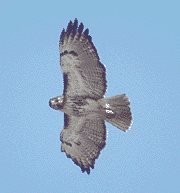
Depending on when you visit Raccoon Ridge, you will have an opportunity to see the migration of any of the following: northern goshawk, Cooper's hawk, sharp-shinned hawk, red-tailed hawk (left), red-shouldered hawk, Broad-winged hawk, rough-legged hawk (above), golden eagle, bald eagle, northern harrier, osprey, peregrine falcon, merlin, American kestrel.
New Jersey is one of the top birding and hawk spotting areas in the USA. And, in 1994, the 12 New Jersey hawk-watches tallied 160,000 hawks during the fall migration. Raccoon Ridge alone, averages about 15,000 raptor sightings each year, during the September to December period.
Raccoon Ridge is most easily reached from Yards Creek Power Station,
just outside Blairstown. But since the attacks of 2001, the route is
generally inaccessible. The next easiest route is probably from the Mohican
Outdoor Center on Camp Road on the ridge above Blairstown. Take Interstate
Route 80 to Exit 4 and Route 94 North towards Blairstown. Drive about
6 miles until you see Mohican Road on your left. Turn left on Mohican
Road and head uphill for 3.5 miles to Gaisler Road. Turn left on Gaisler
and proceed a half mile to Camp Road on
your right. The gravel road leads to the Mohican facility.
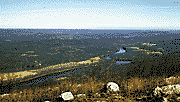
Park you car and head from Mohican on the Appalachian Trail southwest about 2 1/2 miles, about an hour's walk to Raccoon Ridge. The views down the slope to the lower reservoir at Yards Creek are delightful, and serve as useful excuses to slow down the heart rate without confessing to your colleagues that you are definitely feeling the ascent. Woodpeckers seem to own this area, along with the ever-present chickadees, tufted titmice, and nuthatches.
On top of the ridge, if the day is clear, you will see panoramic views of the Delaware Valley, the best being from the Raccoon Ridge overlook itself. You will know you are there because there is a large pile of rocks that serve as a table for the official counter. If you visit there during the count, you will likely find quite a few folks taking in the show. If you are a novice, listen to the experts--they will usually call out key sightings.
Bring a picnic lunch and binoculars. The activity is best on a sunny day, when the wind is out of the northwest, but in any case the action often seems to come in waves--so be patient. If your legs need more action or you want more privacy for lunch, continue south on the Appalachian Trail. After a scenic walk of a little over two miles, and you will reach the north side of Sunfish Pond--a very nice place to have your banquet. But, be sure to return to the overlook to spend some time with the birding folks.
Raptors are wonderful to see. They glide quietly and effortlessly as they ride the thermals but, with the exception of the Osprey (the fish-hawk), most raptors will avoid crossing large bodies of water--they must conserve energy and need thermals to help gain altitude. That is why Cape May is such a good spotting area. The raptors will funnel down to Cape May and spend a lot of time thinking (oh that's right, birds don't think) about how to get to Delaware. They cluster there, and many will go back up the west coast of NJ until they feel better about crossing the Delaware Bay. Others will wait for a hefty tail-wind to help in the crossing.
Two species of raptors migrate well into South America. For example, the six-week-long caravan of broad-winged hawks will make a right turn when they hit the Gulf of Mexico. At that point they will follow the coast through Texas and Mexico as they head for central South America. The Osprey are somewhat more at home with water and will migrate all the way to Argentina, crossing both the Gulf of Mexico and the Caribbean--island-hopping along the way. Experts in navigation, all species of raptors will usually return to the same area year after year, often pairing with the same mate.
Birding is a wonderful pastime and, for many of us, it can become quite habit forming. But it is also very relaxing, and can carry you away from the noise and cares of the everyday working world.
Find out more about raptors and birding in general with a visit to the New Jersey Audubon headquarters at the Scherman-Hoffman Sanctuary in Bernardsville (Phone: 908-766-2661). The gift shop there has many books on birding, and it is a nice place to browse.
Hope to see you on the mountain.