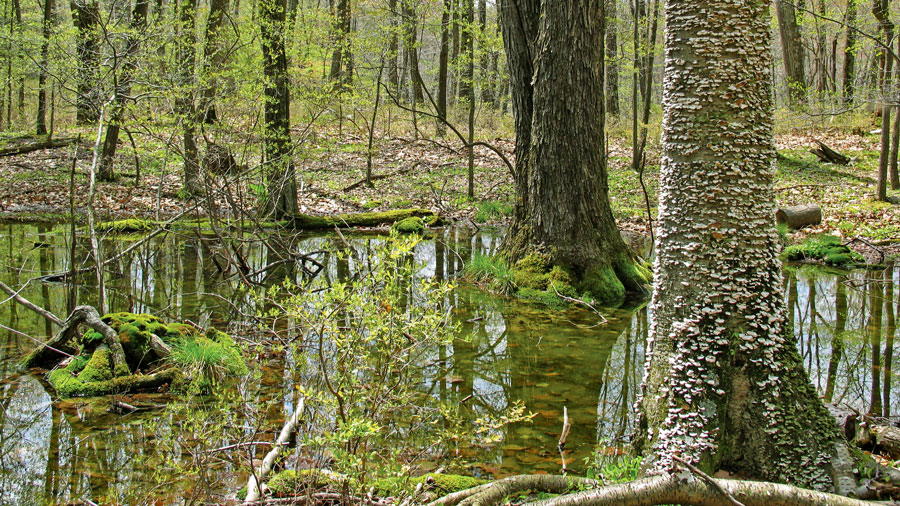
This spring, head for the woods on a special type of hunt. You won't find explicit directions, but if you log any appreciable trail time in the spring, you'll eventually come across a vernal pool. These distinctive wetlands are seasonal surprises, maybe something that you've never noticed before. The pools play hide and seek with woods walkers and the critters that inhabit them. With them it's "now you see 'em, now you don't." They exist for at least two months after snow melts and rain falls enough to fill them up. As summer's hot weather approaches, their water evaporates, and they disappear. Because they are uninhabitable for fish, seven sensitive species of amphibians -- five types of salamander and two frogs -- depend on the exclusive world of vernal pools for their survival. Another fourteen species are able to thrive in the environment.
Easy to find, they look like big puddles -- a bathtub of clay in the woods. Vernal pools can arise in areas that simply don't drain well and accumulate rainfall or snow melt. Others are depressions where you can see the water table. Some may be man-made. Different kinds depend on the local geology. "In the Pine Barrens, they're basically at water table," says Emile DeVito, zoologist and manager of science for New Jersey Conservation Foundation based in Chester. "On some of our restoration projects in the Pine Barrens we try to recreate vernal pools so we can increase the amount of habitat." They dig down to the water table.
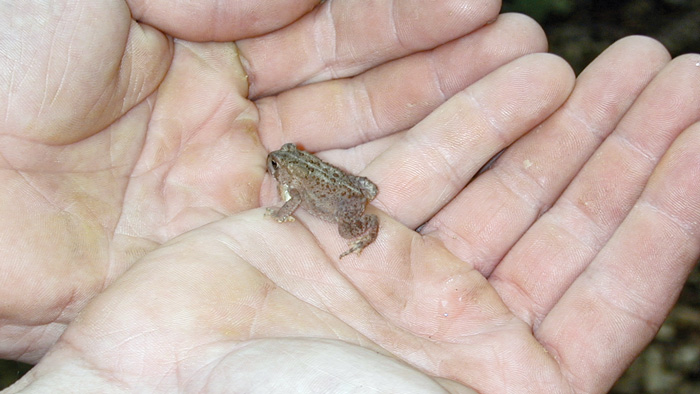
In the Skylands area, the more common vernal pools are depressions in the forest, unconnected to a stream, with a dense soil layer, usually clay, that impedes the water from flowing out easily. The water is shallow, often no more than a foot or two deep with last autumn’s leaf litter still visible beneath the surface. The edges are soft and muddy, ringed by skunk cabbage pushing up through the muck, its purple-green hoods already unfurled, and clumps of sedges and moss beginning to green. Overhead, the forest canopy is still mostly bare letting in plenty of sunlight that warms the water just enough to trigger amphibian calls. The high-pitched peeping of spring peeper forms a constant background chorus, while the quacking calls of wood frog echo from the shallows. Occasionally, a deeper trill from a American toad rolls across the water. Look closer at the water’s surface and you’ll see gelatinous clusters of eggs—clear masses with black centers—attached to submerged sticks and grasses. These belong mostly to wood frogs and spotted salamanders. Beneath them, tiny fairy shrimp drift upside down, moving in slow, delicate pulses.
"If you hike in the woods you are going to see a vernal pool," DeVito assures. "This habitat is also important to people, because if vernal pools dry up it means we're taking too much water out of the water table and we're depleting the aquifer."
The Highlands Regional Master Plan, implemented by the New Jersey legislature to preserve the state's water supply, has targeted vernal pools for protection because they "contribute significantly to local biodiversity by supporting plants, animals and invertebrates that would otherwise not occur in the landscape." The species that breed in them need the water as a place to lay their eggs, attaching them to roots, grasses, or little stems. Free from predation by fish, the amphibians go to the pond to breed, then head back into the forest where they become a significant food source in adjacent habitats. In conjunction with Rutgers University's Center for Remote Sensing and Spatial Analysis, the NJ Department of Environmental Protection has surveyed and mapped over 13,000 vernal pools statewide. The Highlands Water Protection and Planning Council proposes to use this and other data to draw conclusions; then to educate and assist municipalities in creating protective policies.
New Jersey Conservation Foundation, a private, not-for-profit organization that acquires strategic properties with grants and donations, is able to protect vernal pools on their lands. But the Wetlands Law does not generally protect them because they're too small, says DeVito. The pools are endangered throughout the state, first because people use so much water that the water table drops, drying up the vernal pools. Secondly, builders fill in and build over the pools.
In 2001, the NJDEP tried to protect vernal pools by amending the Freshwater Wetlands Regulations to require an extra 20-foot buffer from houses and to prohibit issuance of wetlands permits in vernal pools. In 2004, the New Jersey Builders Association challenged the regulation in state Supreme Court and won. "Since vernal pools are often very small, builders get permits to fill them in," DeVito says. "They're usually less than one acre in size and you can often get permits to fill a wetland that is smaller than one acre. We tried to change that but we failed. The critical thing is that there are all these things that disappear from the landscape when the vernal pools disappear.
More information: NJDEP Wildlife Action Plan