Maryjude Haddock-Weiler was there at the beginning. After the state legislature enacted the New Jersey Highlands Water Protection and Planning Act in 2004, she was the first person hired at the New Jersey Highlands Council. That same year, the U.S. Congress passed the federal Highlands Conservation Act to protect natural and cultural resources throughout the Highlands region of Pennsylvania, New Jersey, New York and Connecticut.
Why two laws? The New Jersey Highlands lie in the most densely populated state in the country. The region’s environment and economy are intertwined, a fact stressed in the act.
“Environmental sustainability with economic sustainability is the foundation, how we live our lives here,” said Haddock-Weiler, planning manager for the Highlands Council.
She recently led a branding effort for the New Jersey Highlands that the council will use to promote tourism in the region.
The 3.4-million-acre Highlands region is a dynamic landscape of ridges and valleys, working lands and natural areas between the Appalachian Mountains and the Atlantic Coast. Remarkably, much of the area is still forests, farms and wild places.
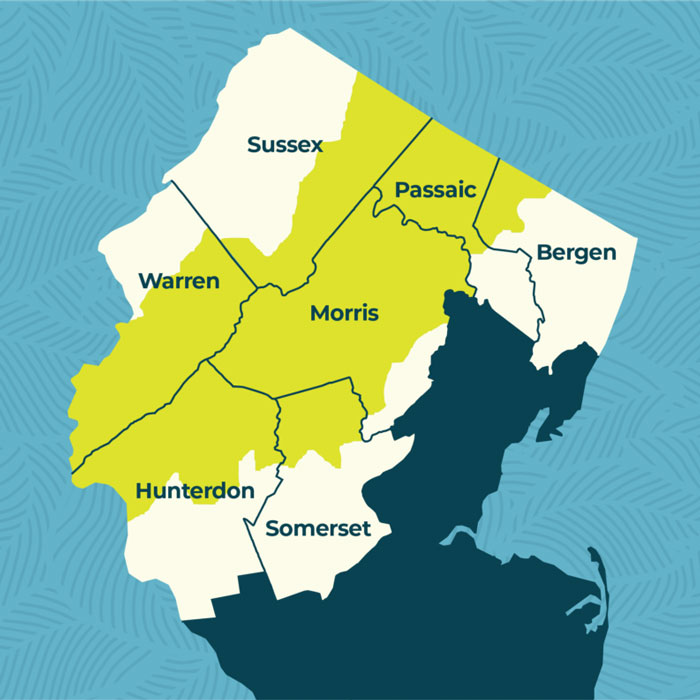
The federal Highlands Conservation Act grant program helps communities conserve working lands and important conservation areas, to preserve the region’s character and health. In the last two decades, the U.S. Fish and Wildlife Service has granted $52 million to state conservation agencies, counties and municipalities to conserve more than 19,000 acres in the four-state region.
While the New Jersey Highlands region covers only about 15% of the state, it provides some or all of the drinking water for 70% of residents. This outsized role led to passage of the New Jersey Highlands Water Protection and Planning Act, which not only recognized the region’s value as “an essential source of drinking water” but also highlighted its “desirable quality of life” and the need to “ensure the economic viability” of its communities.
"The act recognized that, in order to protect the Highlands in the long run, it was also important to protect the regional economy,” Haddock-Weiler said.
The legislation created the Highlands Water Protection and Planning Council — Highlands Council, for short — an independent body reporting directly to the governor that manages the region jointly with the Department of Environmental Protection. The Highlands Council was charged with creating and implementing a regional master plan for the Highlands region, which was adopted in 2008. A 2018 review of the plan noted the need for a sharper focus on economic development in the region.
Haddock-Weiler led that effort, which culminated in the “Highlands Region Economic Sustainability Plan,” released in 2022. That plan recommended creating a brand for the Highlands, to balance economic sustainability with environmental sustainability.
In 2024, the Highlands Council hired North Star, a Florida-based firm that specializes in place branding, to create a brand and a marketing plan for the New Jersey Highlands. To kick off the project, North Star staff toured the region, led by Haddock-Weiler and her colleague, Carole Ann Dicton, communications manager for the council. While some of the group had been to New Jersey, none had visited the Highlands.
“They were stunned. They were like, ‘Wow, this is New Jersey? This is amazing!’” Haddock-Weiler said. “You come in with a fresh eye, and you recognize things that are incredible, that maybe if you're here all the time, you begin to take for granted.”
North Star gathered information and opinions about the New Jersey Highlands and the work of the Highlands Council through interviews, focus groups, public meetings and surveys with residents, business owners and nonprofit organizations. Responses ran the gamut. While some business owners weren’t keen on restrictions in the New Jersey act, others chose to relocate to the Highlands because they like what the region and the council stand for.
North Star produced a logo in the colors of nature. It includes a leaf icon that doubles as a landscape and the tagline “you never Knew Jersey.” They also crafted a brand narrative using emotional language that captures the region’s nature, history, agriculture, food and accommodation offerings. And they’re creating a website.
"We’re thrilled with the result,” Haddock-Weiler said. “They clearly understood the assignment.”
To get the new brand “out into the wild,” in Dicton’s words, Haddock-Weiler created a Highlands Tourism Expansion grant program to support new or existing tourism initiatives. Eleven grants of $35,000 to $100,000 were awarded to local governments, nonprofits and destination marketing organizations for projects that incorporated the new brand.
“My town had a festival in September," Dicton said. “I walked downtown, and there's this banner with the Highlands logo on it and “you never Knew Jersey.”
In December 2025, the grant program received the New Jersey Tourism Industry Association President’s Award.
“That the association recognizes the Highlands — wow, it can't get much better than that!” Haddock-Weiler said.
And that’s just a start. Once the branding website is complete, the council will launch a full implementation strategy. The potential market is staggering.
“One of the things that makes us unique is that we're sandwiched between New York City and Philadelphia and have access to 20 million people,” Haddock-Weiler said.
While other states in the federal Highlands region — Pennsylvania, New York and Connecticut — aren’t as densely populated as New Jersey, they can learn from the council’s experience.
“The biggest lesson is that economic development is not antithetical to preservation,” Dicton said.
Haddock-Weiler added, “It's also really important to support existing local businesses, like the ones that might be downtown or maybe even just in a little crossroads.”
Thanks to an eye-catching and unifying new look, businesses and organizations — both large and small — can market themselves and the New Jersey Highlands, ensuring the region’s economy is as robust and enduring as its natural resources.