If you have yet to see a black bear up close, you're missing an exquisite example of nature's beauty and majesty. Here in the Skylands region of New Jersey some residents can catch a glimpse right in their own backyards. They are the most common bear in North America and are certainly not strangers to the Garden State. The black bear is present in 11 of the 21 counties. In northern New Jersey this regal creature maintains its presence as a valuable asset as well as a symbol of the last remaining wilderness areas.
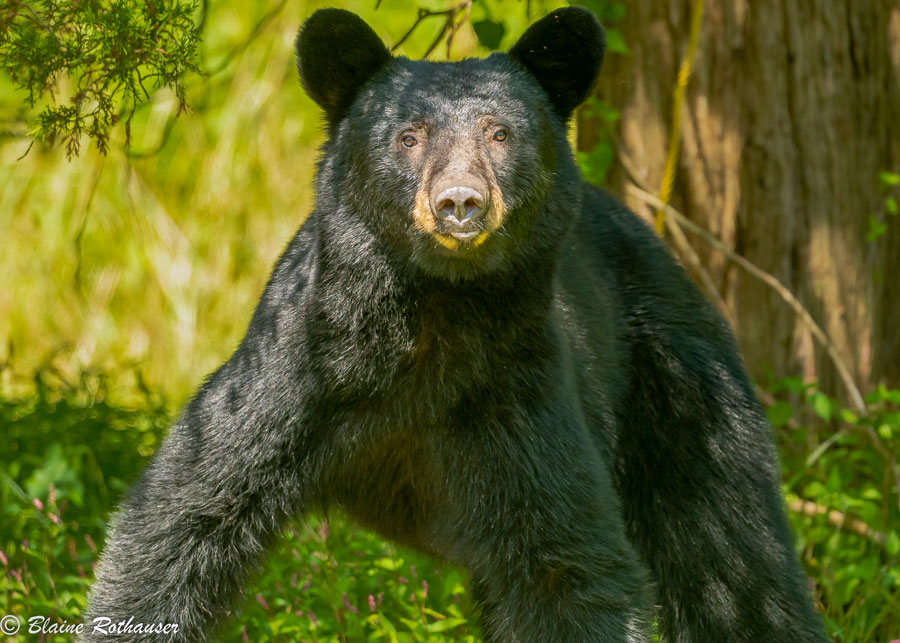
American black bear are approximately five feet long and vary in weight. Females range from 200 to 300 pounds and males are 350 to as much as 600 pounds depending on age, availability of food and time of the year. They are not necessarily black, but may be brown or even cinnamon-colored. Luckily, they are much better than the brown bear at coexisting with humans. Black bears are not typically aggressive. They will usually flee when confronted. They are generally solitary animals except for breeding and raising their young. The black bear population in the Skylands region has risen to 50 times what is was two decades ago. It is at an estimated all-time high of 1,000 animals and growing. There are 600 bears tagged by the Division of Fish, Game and Wildlife in New Jersey. Using current information on birth, death and survival rates on the tagged bears, it is estimated their numbers will double by the year 2006. Humans have taken over much of the bear's original habitat. The loss of their homes has forced the bears to adapt to humans. And this highly intelligent creature has done just that.
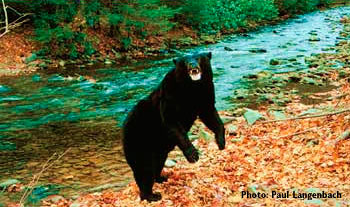
In New Jersey the black bear lives in the wild without any specific designation. Black bear prefer to live in dense cover, such as forests, cedar swamps, thickets, brush and clear cuts populated with saplings. Their choice of home range is determined by the types and availability of food. They roam throughout the summer in search of food sources. Females will travel roughly 10 square miles, and males may go up to 50 square miles from home. Several bears may share the same territory if there is enough food to go around, but the dominant male will defend his territory fiercely. Black bears are excellent tree climbers, even as cubs, and use trees to escape danger. They are also highly adaptable within their habitat; they can live in both arid and moist forests. Although much of the bear's historical habitat has now been populated by humans, this ingenious animal has managed not only to survive but to thrive. Black bears generally live about 10 years, though a few may survive twice that period. The most important known mortality factor for the black bear is vehicle kills. According to the Division of Fish and Game, 46 road-killed bears were recovered in 1999. In New Jersey, black bear commonly live into their teens, which may be due to the abundance of food in this area. According to Patrick Carr, a Wildlife Biologist at the Division, black bears in New Jersey breed at roughly two to three years of age as compared to places such as Montana where the bears are five and six years before they breed. This is due to the optimal food sources here in New Jersey. They have not only an abundance of food, but also a varied selection.

If encountering a black bear, The Division of Fish, Game and Wildlife has these tips:

Stay calm and use common sense. Never approach the animal. Most bears are easily frightened into leaving.

Do not feed the bears! Bears that associate food with people may become aggressive and dangerous.

Keep at least 15 feet away from the animal. If you are at close range, remain standing, avoid direct eye contact. Back up slowly and speak in a calm, assertive and assuring voice.

Make sure the bear has an escape route. Sometimes bears will "bluff charge" when cornered. Yell, bang pots, or use an airhorn to scare the bear away. If the bear will not leave, move to your house, car or building if available. If a bear sounds a series of huffs or snap or pop its jaws and swat the ground, it is a warning sign that you are too close. Slowly back away!

Depending on the season, the bears will find cherries, acorns, grasses, various kinds of berries, tree bark, corn, and even bee hives to choose from. Their fur is bee-proof and the occasional sting on the nose is well worth the honey they may find. Bears are omnivores, meaning they eat many different kinds of animal and plant food. They can eat just about anything of nutritional value. Being opportunistic feeders no food source is ever overlooked. They eat what they find. Although vegetation makes up most of their diet, ants from an anthill, road kill or even the occasion fawn will serve as well. And they will help themselves to seeds in a bird feeder or a squirrel's stash of nuts if they sniff it out.

The bears need to add fat to get through their winter denning period. When they emerge in the spring in a fairly groggy state, they don't eat for about two to three weeks. Then they feed non-stop until September. That last month prior to denning they're consuming up to 20,000 calories a day. They will need 50 to 60 pounds of fat to sustain them through the winter months.

Most people think that bears hibernate, but in fact, they do not. They go through a period of dormancy known as denning. The bears will make a den someplace secluded where they will not be found or disturbed, such as hollow trees, small caves, large excavation under roots of a tree, or the side of a dirt hill. Rugged terrain and dense shrubs provide escape cover and optimal den sites. They will not reuse their dens, but may use an old den of another bear from a previous winter. The space cannot be too large as they will need to conserve body heat. The site will be prepared about one month in advance of their late November to early December denning time.

The bears fall into a deep, yet not unbreakable slumber. They can be startled awake, though I wouldn't want to be the one who does it! And sometimes unseasonably warm weather can fool them into thinking spring has arrived. They may awaken briefly and go out for a walk sort of sleepily. During their extended sleep their body temperature remains near normal at 96 degrees and their heart rate slows to 10 beats per minute. Within this five-month nap period, the bears do not urinate, defecate, eat or drink. All the water and calories necessary are provided to them by the four-inch layer of fat they have established prior to their slumber.

Some time in the months of January or February a female that is in her winter den will give birth to one to four bear cubs. These sows mate normally every other year typically producing 20 to 30 cubs in her lifetime. Black bears mate in June and early July. The boars are drawn to the scent about a week before she actually goes into heat. The bears spend this time kind of "dating," just getting used to each other. The eggs are fertilized and carried inside her fallopian tubes for five months before implanting on the uterine wall. However, if the female does not put on the needed fat for denning, the pregnancy will be spontaneously aborted. Embryonic growth takes two months and two to five cubs will be born in January. They are hairless, blind, and eight ounces at birth. A first-time mother will probably have one cub and commonly twins after that. The cubs grow rapidly and emerge with their mother in May. By 10 months old the cubs may weigh over 50 pounds, but are still easy prey without mother at their side. Humans, brown bears, and male black bears are the most dangerous enemies for the cubs. Even very young the cubs are proficient climbers and use their skill to protect themselves.

The females make wonderful mothers giving their babies constant attention, holding them on their laps in a human-like stance or carrying them on their backs. The cubs stay with their mothers for only the first two winters. Their survival depends greatly on what's learned in this time and their mother's skill in teaching the cubs what to eat, where and how to forage, where to den, and when and where to seek shelter from heat or danger. The cubs are usually independent by the second winter. At five years a typical cub will weigh 200 pounds and can kill a deer of equal weight. A young adult female is often allowed to establish her territory within that of her mother's while subadult males must go out on their own.

Though issues of habitat and human tolerance remain, officials and residents of New Jersey are currently working to maintain this unique predator as a positive part of New Jersey's wildlife.

by Linda Mullin

Comments

wsteinert
07 Mar 2010, 06:14
george kimmerle: Black Bears that live in N.J. are not necessarily black, but may be brown or even cinnamon-colored.
george kimmerle
07 Mar 2010, 05:16
saturday march 6, saw a small brown bear in the rear of our property west of roxiticus road, along the north branch of the raritan river

was walking along the stream and our ducks were very vocal and on guard as it walked away

can anyone confirm that there are brown bears in the area west of roxiticus and south of rt 24, behind the ralston fire house and in the area of burnett and ironia brooks

george k
fosmr
03 Jan 2010, 14:12
Not sure where some of the people posting here are getting the idea that there are no wilderness areas in NJ. I live on the edge of a state forest, which is a great big wilderness area. The Skylands region is FULL of wilderness.
Walter Steinert
22 Nov 2009, 22:04
Branchville, NJ. A Sow with six (6) cubs visited our yard several times over the summer. One time, our dogs (from their kennel) barked and treed the cubs. The mother became agitated immediately & rammed the kennel, breaking the gate hinges. My two boys were playing in the yard next door at the time. If I had a gun and a permit I would have been tempted to shoot the bear. I reported it to the NJ Div Of Fish & Wildlife. They did nothing about it. The year before, a mother with five cubs was the talk of the town. The bears are proliferating at an alarming rate. It may be time for legalizing the bear hunt. Perhaps every other year, to keep the population at a safe level.
glenn spina
19 Nov 2009, 11:06
still looking for bears to photograph. i have been to several northwest parts of nj but haven't seen any. anybody have any specific spots that might be our best bet for pictures of wild bears in nj please let me know--thanks again--glenn
Chris
06 Nov 2009, 12:21
Dont mind my pessimism, But the bear population in Haskell/Wanaque area is growing to concerning levels. I haven't seen a live bear pretty much all my life, Now in Haskell this year alone I've had 5 sightings since June 09' and it's only November. Twice it was in my yard, Whats the real truth behind shooting a bear? I have 3 kids that play outside on any given day with a fenced in yard. Now I should just talk to the bear and open my gate so it can leave and bother someone else? I think not!
dot harding
07 Oct 2009, 09:25
I live in west milford ,we have alot of sightings, we had a huge male in our yard last nite and has been coming back, very scary when it is in your yard, sev. places to hike , but use caution, is Wawayanda state forest and, we often hike with our dogs, also, Norvin green state forest, go to this website,www.nynjtc.org
bryan
16 Sep 2009, 16:02
has any one seen a puma in nj
grassfox
25 Aug 2009, 03:05
Glenn, if you want to see a bear your chances are pretty good in the Ogdensburg, NJ area like Lori said. My wife was in O'burg and saw a bear walking through the grammar school yard ans school bus stop then it walked up the hill behind the town hall, sauntered across High Street and then up Madden Ave where it stopped in a backyard and sniffed around the kids toys before heading up toward Heater's Pond at the top of the ridge line. No guarantees though. Wildlife photography is not a one day event. Seeing bears in the "wild" in NJ is a tough one though. There are no wild areas in NJ. If you want to be guaranteed to see a bear, then Turtle Back zoo is your best bet and their enclosure makes it look like you took the picture while standing next to them in the woods. I can show you where you can take pictures of turtles in Matawan.
GLENN SPINA
05 Aug 2009, 10:59
CAN SOMEONE TELL ME WHERE I CAN SEE WILD BEARS IN NJ TO PHOTOGRAPH AND OBSERVE--I LIVE IN ASBURY PARK AND AM PLANNING A DAY TO GO BEAR WATCHING--IF WE CAN POSSIBLY FIND ANY--IF ANYONE KNOWS A PLACE WHERE THEY THINK OUR CHANCES OF SEEING BEARS IN THE WILD ARE GOOD PLEASE LET ME KNOW SO WE CAN MAKE THE MOST OF OUR DAY-THANK YOU
Julie
16 Jul 2009, 13:35
I was inside my house in Denville two days ago and saw a black bear in my garbage can. He/she wandered into the woods when he was done so I went outside to clean up the mess. As I was lifting the can upright, another bear appeared from the side of the house about 10 feet away. I dropped everything, ran inside and the second bear went to town on the garbage! It was pretty scary!
M
16 Jul 2009, 08:56
A HUGE Brown bear came through my font field this morning. Not black, but brown. Big with a rust-colored face. I live on the border of Randolph and Mendham on 6 acres and my house backs up to a residential neighborhood. I called 911 and then drove to the neighborhood behind us to let people that were outside know. It was a BIG bear. Our neighbors dog (who lives on 6 fence-in acres) has been going crazy for the last two days and nights, acting very strange. This morning she was going crazy barking at the bear and it ran right to the fence and then along the fence to the woods. That dog was relentless. Very scary.
Robert N
13 Jul 2009, 10:05
grassfox you are correct there is less and less wilderness in this state do to the constant building going on and the MCMANSIONS going up. We do need a bear hunt, the state needs to limit the amount of licenses for bow and gun hunters by lottery,and only shoot the males, not Momma bear and her cubs. The bears habitat is srinking ever year. I love nature and I beleive in conserving for our children and theirs. But a hunt is needed. And they have some fact's wrong. Black bears will kill you,your children and your pets and don't ever come between a mother and her cubs You will have no chance against her, like every mom with there babies. You have a better chance playing dead for a Grizzly or Brown bear. If you ever get attacted by a black bear fight for your life. Punch it in the nose and eyes. And if you like hiking bring bear spray with you ( pepper spray ) you can get it any hunting store. Protect your self and family and nature. One last thing grassfox if a bear comes after your grandchildren or you shoot it if you can. I have friends in PA that tell me bears have gone right thorgh glass sliding doors and have trap and attacted people in there houses. If they are hungry and they want in they are coming in. In most cases it's male bears.
Lori
13 Jul 2009, 07:46
I have lived in Long Valley, NJ since Sept 2005 and up till last weekend I had never seen a bear. Well, On Sunday 7/5/09 while out riding through Millbrook, a HUGE black bear walked right out in front of my husband and daughter who were riding on our motorcycle. He was probably about 800lbs! Walked right over a guardrail like it wasnt even there. Then on Saturday 7/11/09 while in Ogdensburg visiting the Sterling Mine a smaller black bear walked right down the stree in front of us at a stop sign then to t op it all off Sunday 7/12/09 while bar-b qing in my yard another small bear came romping through my front yard!!!!
I am still amazed at how many I have seen in just a week. They are majestic but scary as hell!!!!
Melanie
13 Jun 2009, 09:16
I saw my first black bear the day before yesterday, at about noon, while driving down Ringwood Ave in Wanaque. The bear walked right out from some trees and ran across the street and into a clearing behind a house. It was beautiful!
Walt Godek
20 Apr 2009, 17:50
I hike Allamuchy Mountain state park regularly averaging 3 hikes a week all year around and I have seen numerous bears in the North section of the park. Some New Jersey bears are Huge, and I mean Huge! Much larger than images of black bears on nature shows. They are also (Thank God) very timid. One other interesting fact in that they are active all year around. Food sources from dumpsters and Restraunts no doubt contribute to their size. My first siting this year was in January along the Green trail in back of Cranbury lake. This Bear was definitely not in a daze or stumbling around, as I followed his tracks for well over 1 mile until they crossed a south facing slope where the snow had melted. More research needs to be done on these Jersey Giants because they are definitely adapting differently to our area. Oh, Somthing else lives along the Rt. 80 corridor through Allamuchy Mountain, I have seen Mountain Lion tracks numeerous times this winter and last fall I sighted one near the summit of Mt. Allamuchy just off of the Purple trail. LINK to BEar Tracks in January...
http://picasaweb.google.com/lh/photo/JgUu2y6pz7aTD6V4TQzPGg?feat=directlink
grassfox
19 Apr 2009, 16:49
How are bears assets? They are assets only if they can be used as a food source which is why we need a hunting season for bears. Also, it bears (no pun intended) mentioning that THERE ARE NO WILDERNESS AREAS IN NEW JERSEY!
grassfox
18 Apr 2009, 01:16
I know that in New Jersey a person can be fined for intentionally and even unintentionally feeding a black bear. So, if a bear kills and eats one of my grandchildren would I be fined for unintentionally feeding a bear?
jessica
10 Apr 2009, 19:50
how much water do black bears drink each day?
Orion
10 Jan 2008, 12:55
You need to update the info on this page.

You need to submit your comment only once. Please be patient, sometimes our scripts behaves slowly.

*Name:
Email:
Notify me about new comments on this page
Hide my email
*Text:
 
Powered by Scriptsmill Comments Script
Site Contents and Contact Information
Questions and Comments
Advertising and Promotions
-- http://www.njskylands.com -- Revised: January, 2009--
Copyright ©1996-2009 Guest Services, Inc.